eParachute Blog

On finding the work of your dreams, from Dick Bolles & the team at eParachute.

22 blog posts by Gary Bolles

Coaches: Here are 4 Transferable Skills for Your Clients’ Success

Career counselors, coaches, and other professionals who help clients with career issues often ask: How can I help my clients become robot-proof?


I’d start with helping them to focus on four specific transferable skills.


Sure, there are hundreds of transferable skills, and different work situations inevitably demand different capabilities. But four skills stand out that job-hunters, career changers, and anyone who’s working need to focus on. These are:


Problem-solving. As Dick Bolles often said, the main reason someone is hired is to solve problems. It helps, of course, if you’re solving problems you love. But if a worker’s basic frame of mind is on solving problems, they are far more likely to be hired than someone who can’t speak in the language of problem-solving.


Adaptive. It used to be that nothing in life was certain but death and taxes, and in an era of life extension and digital currencies, these might be at risk. What is inevitable is the pace of change: If you thought self-driving cars were in the realm of science fiction, you won’t believe what’s just around the bend. So we all need to be adaptive problem-solvers, because the pace of change isn’t likely to slow down any time soon.


Creative. If you’re just solving the same rote problems over and over again - well, that’s going to be the domain of robots and software. Your clients need to be creative problem-solvers, always bringing their ability to innovate to the table.


Entrepreneurial. There will always be work that allows someone to simply sit and let problems come to them: There just won’t be a lot of it in the future. Workers need to be proactive problem solvers who go find problems and solve them. Now, that doesn’t mean that everyone needs to be an entrepreneur, starting their own business (although that’s a great strategy too). What it does mean is that people need to think entrepreneurially - which is basically to be a problem-solver for a customer or client. Even if a worker’s “customer” is someone inside their own organization, that worker still needs to focus on solving that customer’s thorniest problems.


Of course, it’s not by accident that those four transferable skills - Problem-solvers who are Adaptive, Creative and Entrepreneurial - spell out PACE. The pace of change is accelerating -- and your clients will need to practice these four skills to keep up.


Join us Wenesday May 9 at 10am PT for our second Webinar: 6 Strategies for Your Job Search. It's FREE! Click here to register, space is limited.


39 Comments

Unbundling Jobs

You’ll find after you go through eParachute's career exploration exercises that you’ve learned about three important components of you: Your skills, your knowledges, and your preferred people environment - which also turn out to be three of the most important components of a job.


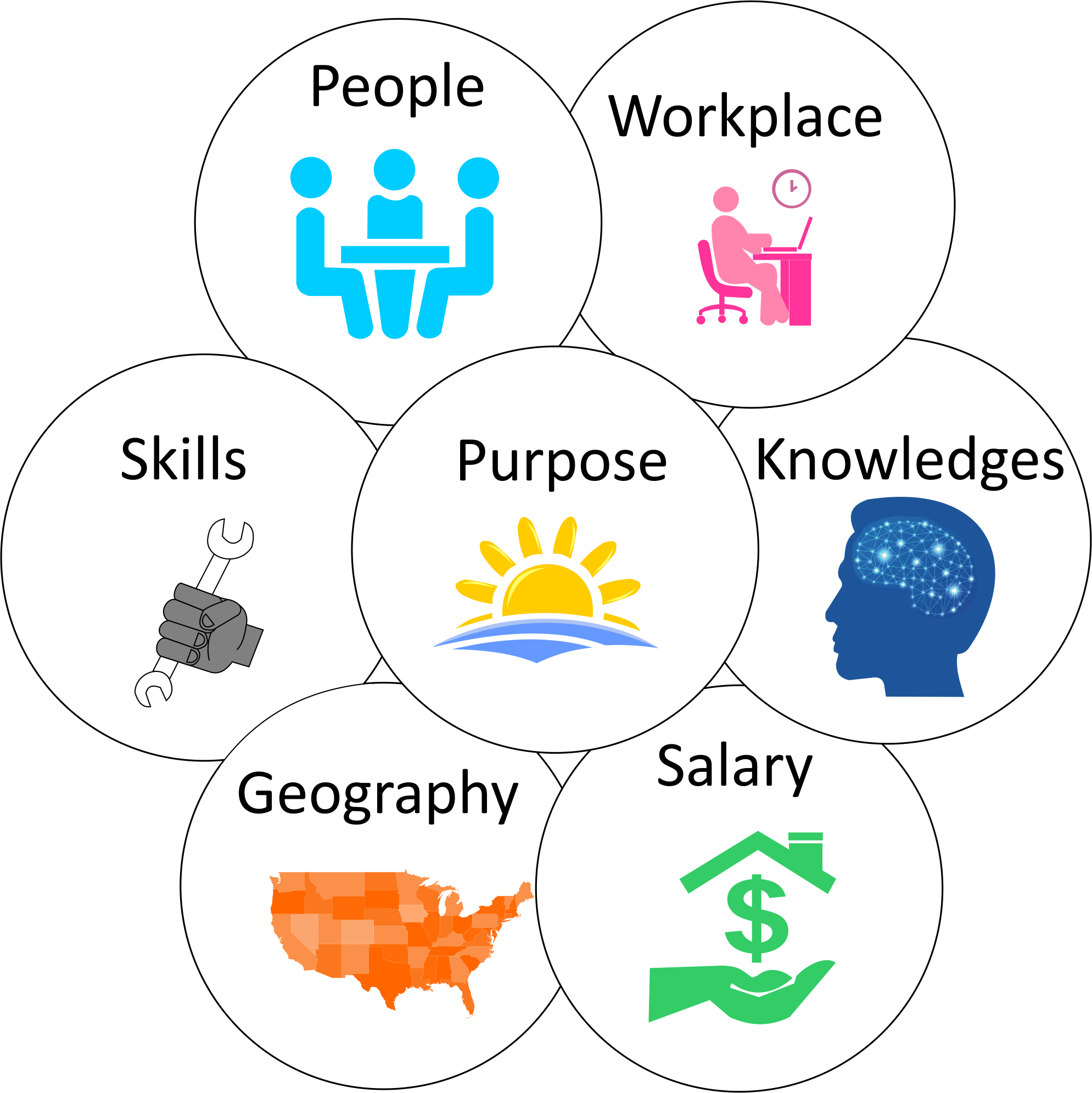
It turns out that, according to Dick Bolles in What Color Is Your Parachute?, work roles have four more important parts. In addition to skills, knowledges, and people, jobs also include the people environment, the workplace environment, geographical location, compensation, and the purpose you feel you’re fulfilling.


The various elements of a work role have traditionally been bundled together into what we call a job.


Technology and globalization have turned these components on their sides, “unbundling” them, allowing them to be separated into different layers, and fundamentally changing the way work is performed.


Take, for example, geography. Many jobs used to require the work to be conducted in a specific location, such as an office or a factory. But with the combination of automation and globalization, a variety of work can be performed in another place -- from your home or a coffee shop, or outsourced halfway around the world.


But automation and globalization have far more seismic implications for work than simple outsourcing: Together, they allow work to become completely unbundled, down to a very granular level. Services like Uber, Taskrabbit, and Mechanical Turk each allow work to be conducted in narrow contexts, dramatically impacting the way we work.


How does an “unbundled job” operate in practice? What happens when, say, there’s a customer who wants to go from point A to point B in a city?


In the past, we called the hirer “A Cab Company,” and the worker “A Cab Driver.” (In 2012, there were about 233,000 cab drivers in the U.S.)


What are the most frequent problems that a cab company has? Taking the customer’s order, dispatching a vehicle to pick up the passenger at Point A, depositing the customer at Point B, and charging the customer.


In a traditional cab company, the tasks needed to solve these problems would have been performed using the skills of the dispatcher, who takes the customer’s order, and tells the driver to pick up the passenger, and the driver, who transports the customer, and takes the customer’s payment.


Along comes Uber. The tasks needed to solve the problems are now performed by an app, which takes the customer’s order, tells the driver to pick up the customer, and takes the customer’s payment; and an untrained driver with a car, who transports the customer.


So, the job of driver and dispatcher have become unbundled. And it’s happening in industry after industry after industry.


Now, it doesn’t mean that all jobs are going to become unbundled tomorrow. Despite the rise of the Internet and new media, we still have old media like radio and record players. Jobs will be around for a long time. But just as unbundling is affecting entire industries, this unbundling is impacting a wide range of jobs today. And it’s going to affect an increasing amount of the work that people do.


That’s why it’s so important for you to do your own self-inventory. The more you know about your skills, knowledges, and other important work-related characteristics and needs, the better you’ll be able to find meaningful work - whether you find it in a traditional job, or in something a little more non-traditional.


16 Comments

More »

Give the Gift of Self-Inventory

After the holidays comes the new year, a time for many people to think about what will make the next year even better than the previous one. So why not jump in with a present that can help young and old to envision a more fulfilling future? Give the gift of self-inventory, with eParachute.


For high school students, it’s an opportunity to learn more about themselves. Taking a few minutes can bring the important insight that their unique skills and other attributes can be connected to college majors they might never have considered.


For college students, it’s a way to think in new ways about what they’ve already learned, and what might be the most interesting and exciting things to learn in their remaining time in school.


For those who are approaching college graduation, self-inventory is the first critical step into the world of work, helping them to take inventory of their knowledges and experience, and to consider work options that might never have occurred to them.


For relatives and friends who’ve been working for years or decades, it’s a valuable opportunity to synthesize all they’ve done and learned, and to re-assemble those skills and knowledges into a variety of new opportunities that could provide more meaningful work.


Whatever the time of life or work circumstances, taking a few minutes to gain new insights into what makes each of us unique, and how those characteristics and experiences can translate into a new role in the world of work, is a gift that keeps on giving long into the future.


9 Comments

More »

Take Me Back to the Start

Sometimes when you’re reimagining your career, it can be challenging to think about what might make you excited. Especially if you’ve been stuck in what you think of as a dead-end job, it can be hard to get a mental picture of what could be an enjoyable line of work for you in the future.


So, if it’s challenging to picture something about your future, sometimes it can be helpful to go back to the start.


When we’re young, we have many fewer filters on the world than we do as we get older. As the world lays an increasing number of responsibilities on our shoulders, we became laden with “should’s” and “must’s” and “have to’s.”


So, ask yourself: When I was young, what sparked my imagination? What fascinated me? What did I study, not because I was told to, but because I wanted to?


Perhaps you were deeply interested in astronomy, or knitting, or sports, or math. That doesn’t mean that you should suddenly drop everything and become an astronomer, or a clothing maker, or an athlete, or a mathematician. But it can provide you with a spark or two - memories of topics that interested you in the past, and may hold the key to some things that may interest you in the future.


Now, there’s one risk about doing this. What if you thought back to when you were younger, and rather than getting excited, you became disappointed? What if all you focused on was what you haven’t done since you were young, instead of what have done?


Well, that’s probably not the most helpful takeaway. Any career change should always be forward-looking. We like to say, career planning uses your experiences of the past, filtered through your perceptions of today, to come up with what you might be able to do tomorrow. So, your opportunity is to develop ideas about what you can do from now on, as you imagine what your next steps might be.


Another way to get some good ideas for options to explore is to take JUMP on eParachute.com, and once you complete the program, surf through the various work options listed. Take one or two of the suggestions that interested you, and use them as a jumping-off point for some research. It’s entirely possible that you may be able to infuse some element from your childhood passions into work that you can do in the future.


8 Comments

More »

Creating a Picture of Your Next Career Step

As humans, we’re image-driven creatures. We have a marvelous ability to visualize pictures of everything from previous experiences to future activities. You can leverage that ability to your own advantage when you’re envisioning your next career step. 

To build that clear picture, it’s important to start by avoiding any thought about being realistic. When people tell you to avoid dreaming about the future, they probably mean well. But their advice is typically going to be rooted in their own experience or observations - and if they’re not doing something that really motivates them in their work, chances are good they’re going to anchor you to the same “reality” they believe in. You need to dream.

Start by making a list of the topics and activities that are most interesting to you. What do you regularly read about? What topics interested you when you were younger, and still hold some fascination for you? What do you already know something about, and which you’d like to learn more about?

Next, go to eParachute.com. You’ll get a variety of insights about yourself, including your best-loved skills and knowledges. You’ll also receive a set of ideas about the kinds of work you might find exciting to explore, or subjects you might find interesting to study.

Look at the range of suggestions for the kinds of work you might do. Take the pieces from each suggestion that really resonate with you. Make a list of all those elements. Add any others that would make this kind of work even more interesting.

Now you have a great starting place for your picture. If you’re really visual, you might even want to make a real picture, drawing the various aspects of your ideal job. Don’t worry about the art itself; just draw something to satisfy you.

Whether you actually drew a picture or not, take your image of your ideal work, and start talking to people about it. Who might you know who’s doing this kind of work, or something similar? If you don’t know someone directly, who might know somebody who knows somebody? Keep talking to people, and you’ll keep getting closer to something in life that’s close to your picture.

Now, it’s not likely that you’ll find absolutely everything that’s in your ideal picture (though that could happen). But use that image as your guide, and you should be able to develop

Okay, now that you’ve dreamed, you need information. Who does the kind of work that fascinates you? What kinds of organizations do they work in? What can you learn about their work from research online? Hopefully, the more you learn from research, the more excited you can become about the kind of work that you might do.

But online research can only take you so far, so the next step is to actually go out and talk to people. Your research should have helped you uncover the kinds of organizations where people do the kind of work that excites you, so now you need to approach people in those organizations who can help you learn more about that kind of work. Remember that you’re not looking for an actual job: You’re just trying to find people who share your passion. Find out how they got into their line of work, what they love (and don’t love) about their work, and where there might be others in their field that you could speak with.

By giving yourself permission to dream, and by actively searching to find people doing the kind of work that jazzes you, you’ll gain a wealth of knowledge about the kinds of work that would make you thrilled to get up in the morning. 

11 Comments

More »

Permission to Change

What keeps you from making a big change in your life? Sometimes it’s because you think you need permission from someone - maybe even from yourself.


Why do we need permission? As we mature into adulthood, we take on a variety of obligations. We often get married, and have kids. We buy things like cars and houses. We have ups and downs, financially. And we have ups and downs, health-wise.


All of those perceived obligations can add up. And even if you think you might be happier doing something different, career-wise, you may feel that those obligations keep you from being able to make a change.


To really navigate a career change, or to find meaningful work if you’re unemployed, it’s important to feel like those in your life are supporting your journey. Make a list of the people whose approval matters to you. Spouse? Parents? Kids? Friends? Mentors? Include anyone who comes to mind.


In some cases you may simply need to tell them what you’re doing; in other cases, you may need to have a long discussion about your goals and plans. Next to each name on your list, jot a few bullet points about what you think their questions or issues might be. It’s important to challenge those assumptions: Maybe they’ll be completely supportive from the start, so don’t pre-suppose that they’ll be opposed.


Look at your list. There’s probably one person missing: Yourself.


The first step, of course, is to give yourself permission. A lot of the perceptions about obligations are yours. It’s critical that you feel you’re headed for a new kind of work that’s really meaningful to you, and that can provide you with the income you need, If you already have that kind of work in mind, great. If you don’t, start with JUMP.


The insights you get from JUMP, and any other self-assessment work you do, such as the eParachute Udemy course , or What Color Is Your Parachute? , are essential for the process of building a clear picture in your mind of what you’re aiming for in your career move. The clearer you can make that picture, the more you can overcome others’ - and your own - questions about your next career step.


9 Comments

More »

Who Are You, Online?

Maybe you don’t spend a lot of time using social media. Or, maybe you do a lot, posting every day on Twitter, Facebook, LinkedIn, Instagram, Pinterest, and more. Or, you could be doing something in between.


You’re probably using them more if you’re younger. But older people are often more active than you might think: over two thirds are on Facebook, and more than a third of people 50+ say they do Facebook posts regularly.


Even if you’re only posting every now and then, though, you’re leaving a record of your activities and your life. And most of that is information that prospective employers can see.


Okay, so try this: Google yourself. Just type your name in online search. First, just type in your name, and see what comes up. Then, type in your first and last name, and put them in quotes. You should get reasonably similar results. If you need to, add some more keywords to identify yourself.


If you want more information about what others see, ask a friend to Google you, too. Different people can get different results.


Now, think about what you’ve learned from taking JUMP. Does anything that comes up that reminds other people about your best-loved skills, and the knowledges you enjoy the most? If not, maybe you should be posting more about them.

113 Comments

More »

Why You Shouldn’t Be “Realistic”

In the new online video course, "The eParachute Introduction to Your Career and Job Search" - otherwise known as "The Flower Course" - "What Color Is Your Parachute?" author Dick Bolles gives a strong admonition. When it comes to thinking about your next career step, he states unequivocally, "Don't be realistic."

Why would he suggest something like that? Shouldn't you start off by grounding yourself in reality, and admitting that life's unending restrictions will simply reel us in whenever we try to dream?

No way.

If you start off by talking about all the "shoulds" and "have-tos" and "musts" in your life - if you begin by simply looking at your restrictions, rather than imagining what's possible - you'll limit yourself from the start. By constraining your options, you'll simply guarantee that you'll be doing work that doesn't excite you.

No, the key to finding your passion in work is avoiding any talk of being "realistic." Instead, you need to really let your imagination fly. You need to build a picture of the kinds of things that could draw and keep your attention, and that will only happen if you can let your dreams soar.

Your first clue is the topics that interest you. What fascinates you now? What do you enjoy reading about? What were the kinds of things that really jazzed you as a kid? Do any of those interests still hold your attention now? The "Knowledges" segment of the Flower Course will help you to envision these areas of interest.

Or, here's another way to approach it. Ask yourself this simple question: If I could wave my magic wand, and do anything in the world of work, what would that be? What kind of activities would you do in a given day? What kind of people would you work with, and perhaps even help? What would your working environment look like? What kind of values would anchor you in your work? And so on.

Again, the Flower Course will help you to flesh out each of these areas of interest, and to prioritize them so you know exactly what kind of work would excite you the most. It's only by giving yourself permission to dream that you'll gain a wealth of knowledge about the kinds of work that would make you thrilled to get up in the morning.

21 Comments

More »

A Purposeful Flower

If the core of finding meaningful work is self-inventory, then the core of career self-inventory is The Flower. Devised by eParachute co-founder Dick Bolles, The Flower represents the seven most important factors about a job - and therefore the seven most important factors about you in your work.

In the past, some might have said that, of all the seven “petals” of The Flower, the most important is an inventory of what you know - your Knowledges. Or perhaps of your Skills - those abilities that can transfer between various situations. Others might have chosen Geography, or Salary, or People Environment, or their Work Environment. But increasingly today, more and more people say that the most important of the seven “petals” of The Flower is Purpose.


Purpose can be many things. It could be what you feel is your Mission in life - whatever drives you to accomplish something in service to a higher goal. Or it could be your Philosophy of life, a set of values that you feel compelled to put into action. Whatever context resonates the most with you, your Purpose is a statement about meaning - and that serves as the foundation for your search for meaningful work.


Why is Purpose so important to talk about? eParachute is releasing a new course with its partner Udemy, and that course takes people through a series of exercises to complete The Flower. Job-hunters might see the course as an important set of steps to understand the most effective choice for their work. And career changers might view the course as a way to determine a new path in the world of work.


They’d both be right. But what becomes clear once you’ve done your self-inventory of all seven petals, is that together they can constitute what makes work meaningful for you - and that means that The Flower course is really about Purpose. With your Flower, you’ll have a complete picture of the various facets of work that provide meaning to you, as you’d define it today. (You might define things very differently tomorrow, and in fact that’s to be expected, as a living and growing person.)


Find that work, or something very close to it, and you’ll find a way to express your Purpose.

Sign up before June 30 to receive an “Early Bird” discount code for "The eParachute Introduction to Your Career and Job Search: Discover Your Purpose & Ideal Career w/ the Author of the #1 Career and Job-Hunting Book “What Color is Your Parachute?”on Udemy.com. http://eepurl.com/bqZckb


64 Comments

More »

Tips for Finding Summer Work

If you’re in high school or college, and you already have summer work lined up, congratulations.

But if you’re still trying to find an internship or a paying job, it’s time to get creative.

Finding a work opportunity when you’re young can be a little easier if you’re willing to go without pay (also known as an internship) to get some on-the-job learning experience, or to bulk up your resume.

You should definitely begin by asking your parents’ friends for suggestions for places to look. You can also do some online research to find local businesses doing the kind of work that interests you.

Remember that doing unpaid work doesn’t mean doing unprofessional work: Dress to your professional best, and take copies of your (one-page, highly proofread) resume directly to these organizations. Politely ask if any part-time unpaid internship work is available - and if not, ask if they might have a suggestion where else you could look.

From asking your parent’s friends to speaking with people when inquiring for work opportunities, finding the work you want centers around relationship building – so make a great first impression, ask for what you want and eventually this will lead to doors opening.

The same advice goes for seeking paid work: Canvas local businesses, especially ones in the fields that interest you, because your enthusiasm will be that much more genuine. You will dramatically increase your chances of being hired if you’re reasonably mobile---either having access to a car, or public transportation---and look for part-time work in person instead of sending out resumes via email.

Cobbling together two or three part-time jobs from different businesses means you won’t be asking any one company to pay you full time, which is much easier for a small business to take on, and you will have more  variety of experiences as well!

If you’ve tried targeting specific kinds of businesses that interest you, but haven’t had any luck yet, don’t give up!  Cast a wider net and check out the shops near you. Even if they don’t have work available, local shopkeepers who know you are far more likely to give you suggestions where else you might look.

If you still have trouble finding work, another strategy is to offer to work at a business without pay for a week, to show an employer how hard you work, and then to negotiate for pay.

Don’t get discouraged! At first, you may find that opportunities in your area are hard to come by. But perseverance pays off. A man named Richard Lathrop said that looking for work often looks like this: NO NO NO NO NO NO YES. Remember that each “no” gets you closer to a “yes,” so keep on trying.

43 Comments

More »

© Copyright 2012-2013 by eParachute, Inc - All rights reserved.